Lodge St. Fothad's Auchterderran No.1059
As part of the Provincial Grand Lodge of Fife and Kinross, we uphold Masonic traditions and values in our community-focused gatherings.
Our Fraternity has a wonderful history, which dates back more than three centuries. It is one of the world's oldest secular fraternities, a society of men concerned with moral and spiritual values. Founded on the three great principles of Brotherly Love, Relief and Truth, it aims to bring together men of goodwill, regardless of background and differences.
History of the Lodge and Patron Name
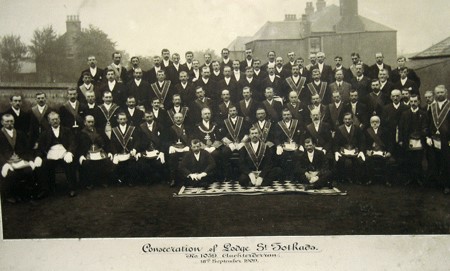
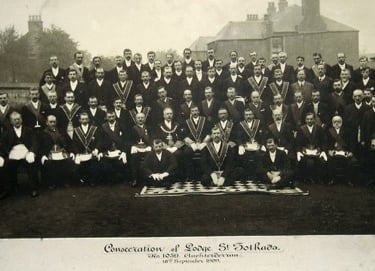
On 10th April 1909, a petition to grant a Charter for a Masonic Lodge, to be known as Lodge St Forhad’s Auchterderran Fife was raised by Brethren living and working in Cardenden and the surrounding area. The Consecration Ceremony was held in the Bowhill Hotel, Cardenden, the original home of Lodge St Fothad's Auchterderran, Fife on 18th September when the photograph on right was taken.
Our Lodge is Named 'St Fothad's' after Bishop Fothadh, the Patron Saint of the Parish of Auchterderran wherein the Lodge is situated.
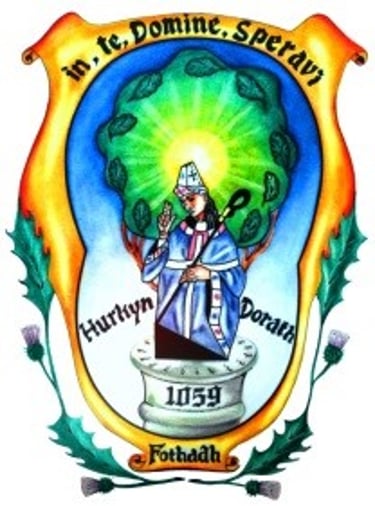
Hurkyndorath is the original name for the Parish and both St Fothad and the word 'Hurkyndorath' feature in the Lodge Crest worn by the RWM and Wardens. They also appear on the Centenary Jewels produced in 2009.
Most of the founding members were Miners, employed by the Fife Coal Company in one or other of the three collieries in operation in the area at the time, The Josephine at Bowhill, the Minto at Brighills and the Lady Helen Colliery at Dundonald.
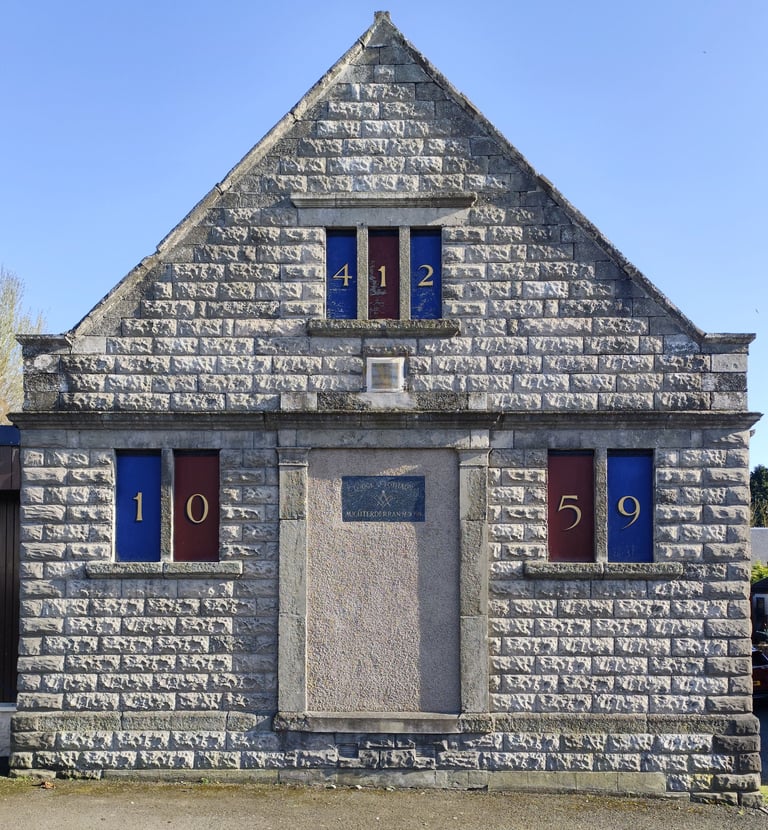
The Lodge was given the number 1059 on the Roll of The Grand Lodge of Scotland, (a most appropriate coincidence, 1059 being the year Fothadh became the chief Bishop of St Andrews and in effect the Patron Saint of our Parish of Auchterderran. One school of thought is that Bro A. McNeill Houston and Bro Charles Hunter, knowing the significance of the number 1059, delayed registration to ensure that the 'coincidence' occurred).
After moving from the Bowhill Hotel to the adjoining Hall, before 5 years had passed, The Lodge purchased the Masonic Hall situated next to the Bowling Green by the Miners’ Welfare Institute, Station Road from where it operated for many years. However, the minutes of the meeting held on 6th December 1966 record that the structure was 'in a bad state'
Events moved quickly and on 28th March 1967 a Special Meeting was held to hear reports from Messrs Hardie & Co, Assessors and a representative from the Town and County Planning Officer’s Department about the Church Building. After lively discussion, it was proposed by PM Bro Eddie Scott and seconded by IPM Bro James T. Miller that the Church Building be purchased at a price of £350.00 and this was agreed to by the Brethren present.The plans for the new Lodge were finalized and presented to the Lodge Committee on 3rd October 1967 and work commenced the following September, volunteers being asked to assemble at the premises on Sunday 29th September to commence Alterations and Building works. The tradesmen who carried out the work gave freely of their time and effort.
The Consecration of the building was carried out by Provincial Grand Lodge on 18th April 1970. Following the recommendation from Grand Lodge after meetings, discussions and preparations, on 23rd January 1973 a special meeting was held at which the draft Constitution and Laws of the Social Club were approved and St Fothad's Social Club created. The Social Club Committee is responsible for organising the various social events throughout the year, including: A Ladies' Night; A celebration of our National Bard, Bro Robert Burns; A celebration of our National Saint, St Andrew and a Hogmanay Social to see in the New Year.
For more details about fascinating history of the Lodge, please download prepared PDF file
For more details about incredible history of the Fothadh and Hurkyndorath and further reference to Cardenden Parish, please download prepared PDF file
The Story Behind This Beloved Emblem Of The Craft in Germany.
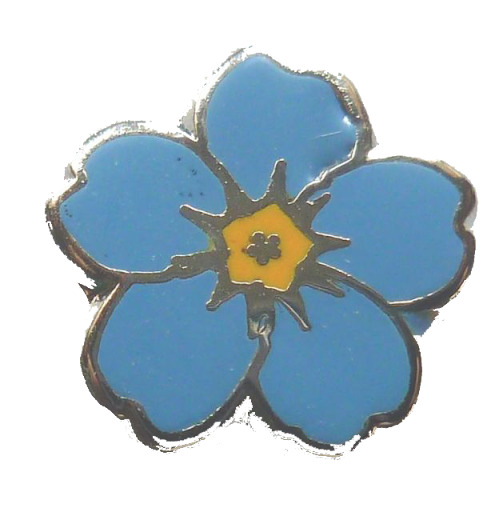
In Early 1934, soon after Hitler's rise to power, it became evident that Freemasonry was in danger. In that same year, the "Grand Lodge of the Sun" (one of the pre-war German Grand Lodges, located in Bayreuth) realizing the grave dangers involved, adopted the little blue Forget-Me-Not flower as a substitute for the traditional square and compasses. It was felt the flower would provide brethren with an outward means of identification while lessening the risk of possible recognition in public by the Nazis, who were engaged in wholesale confiscation of all Masonic Lodge properties. Freemasonry went undercover, and this delicate flower assumed its role as a symbol of Masonry surviving throughout the reign of darkness.
During the ensuing decade of Nazi power a little blue Forget-Me-Not flower worn in a Brother's lapel served as one method whereby brethren could identify each other in public, and in cities and concentration camps throughout Europe. The Forget-Me-Not distinguished the lapels of countless brethren who staunchly refused to allow the symbolic Light of Masonry to be completely extinguished.
When the 'Grand Lodge of the Sun' was reopened in Bayreuth in 1947, by Past Grand Master Beyer, a little pin in the shape of a Forget-Me-Not was officially adopted as the emblem of that first annual convention of the brethren who had survived the bitter years of semi-darkness to rekindle the Masonic Light.
At the first Annual Convent of the new United Grand Lodge of Germany AF&AM (VGLvD), in 1948, the pin was adopted as an official Masonic emblem in honor of the thousands of valiant Brethren who carried on their masonic work under adverse conditions. The following year, each delegate to the Conference of Grand Masters in Washington, D.C., received one from Dr. Theodor Vogel, Grand Master of the VGLvD.
Thus, did a simple flower blossom forth into a symbol of the fraternity, and become perhaps the most widely worn emblem among Freemasons in Germany; a pin presented ceremoniously to newly-made Masons in most of the Lodges of the American-Canadian Grand Lodge, AF&AM within the United Grand Lodges of Germany. In the years since adoption, its significance world-wide has been attested to by the tens of thousands of brethren who now display it with meaningful pride.
The Forget-Me-Not
(Das Vergissmeinnicht)
Lodge St. Fothad's Auchterderran No.1059
12 Orebank Road, Cardenden, Fife, KY5 0JW.
Contact Details
© 2025. All rights reserved.
Join us at the Masonic Hall in Cardenden, for our meetings.
★★★★★
Community, Tradition, Brotherhood, Integrity